Kaiten sushi is Japan's conveyor belt sushi, with plates from ¥110. How ordering and the bill work, what Sushiro and Kura charge, and 6 Tokyo spots.
Introduction
Kaiten sushi (回転寿司, "rotating sushi") is Japan's conveyor belt sushi: plates travel past every seat, you take what you like, and anything not on the belt you order on a touch panel. Prices at the big chains start around ¥110 a plate, and at central Tokyo branches of Sushiro and Kura the base plate is ¥150 and ¥145. "Kaiten zushi" is the same thing.
This guide explains where kaiten sushi came from, how plates, tea, ordering and the bill work, what each big chain charges, and which rules actually exist. It ends with six Tokyo branches to try. We checked every price, hour and rule against the chains' official sites, the Osaka tourism bureau and Tabelog in 2026, and we say so where a detail is not published.
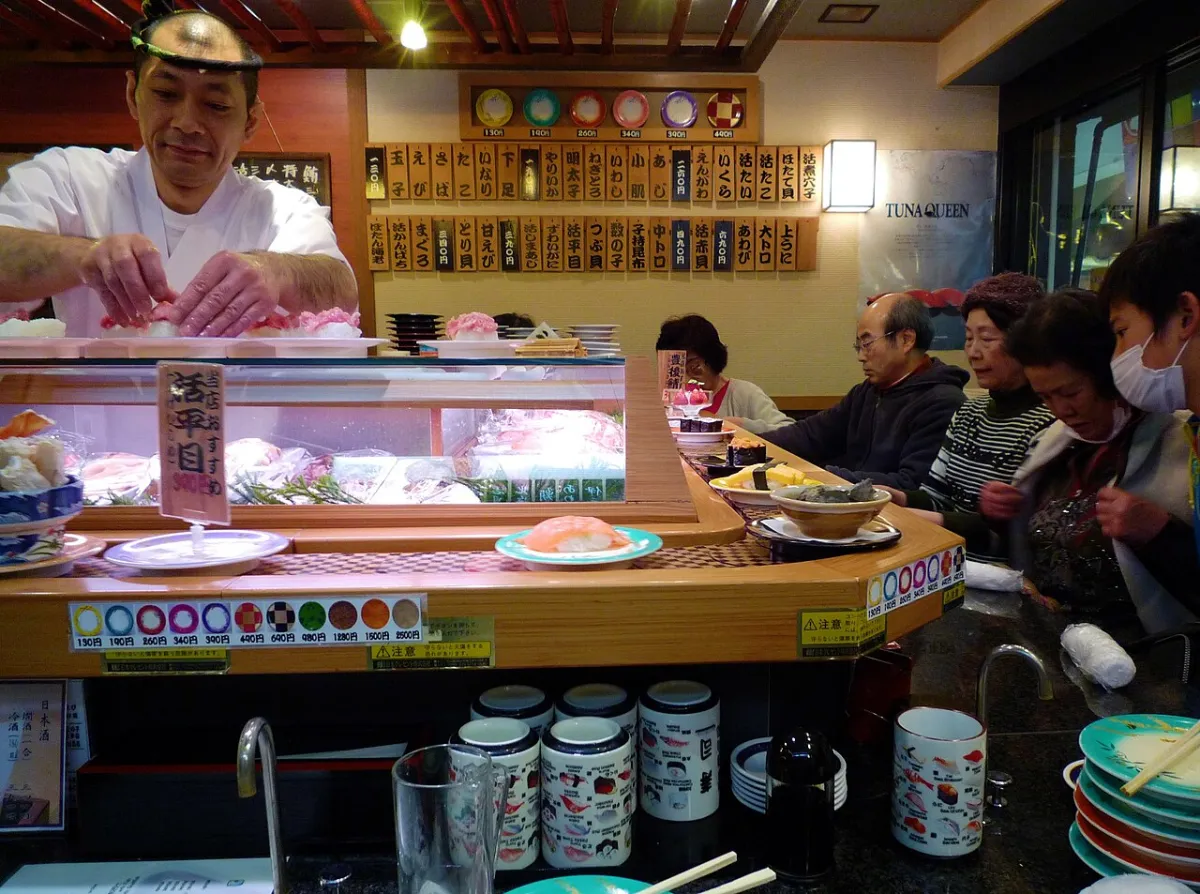
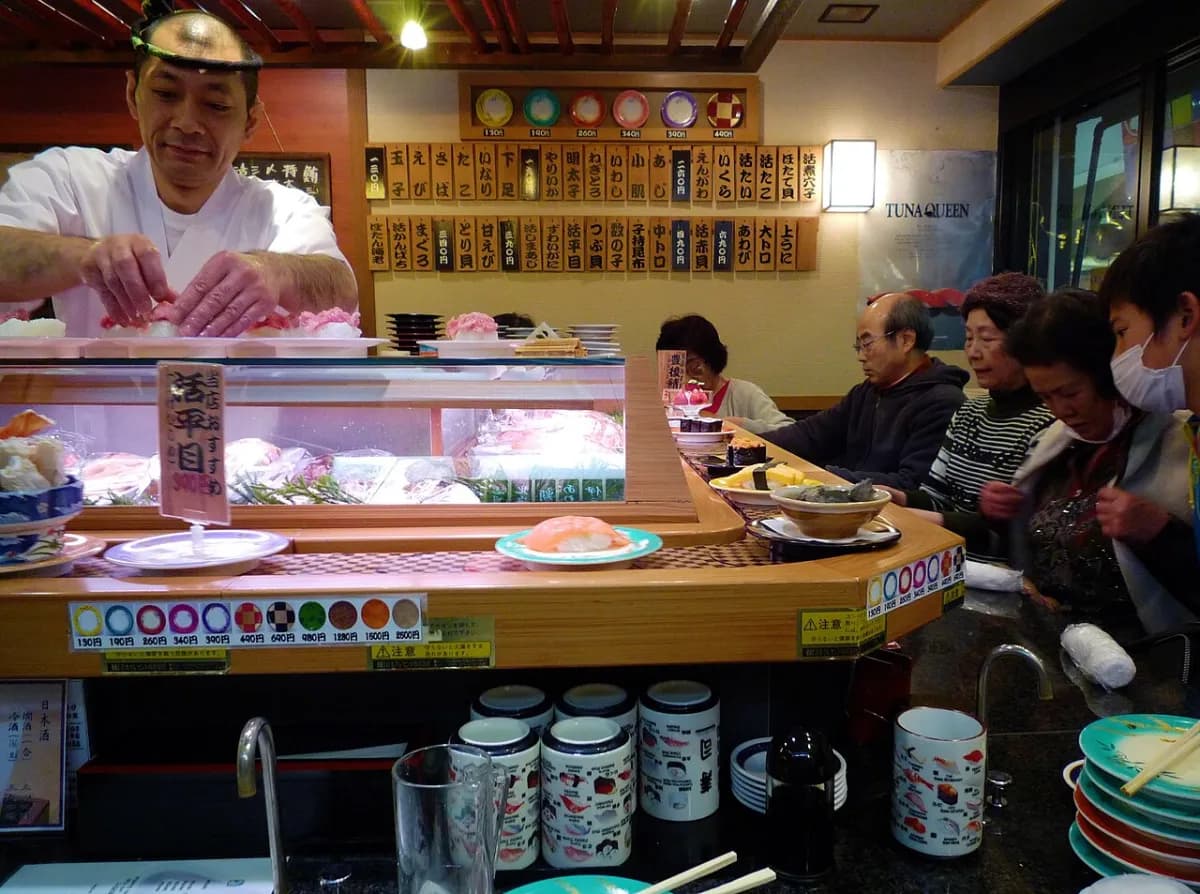
Photo by Alberto Carrasco Casado / Wikimedia Commons (CC BY 2.0)
Generic photo of a kaiten sushi counter, not a branch listed in this guide.
A short history
According to the Osaka Convention & Tourism Bureau's official OSAKA INFO guide to kaiten sushi, conveyor belt sushi was born in Osaka. The founder of Genroku Sangyo ran a small standing sushi shop in Fuse (today part of Higashiosaka) and was struggling to keep up with customers with too few staff. On a tour of a beer factory in Suita he watched bottles ride a belt conveyor and saw the answer.
Building it was slow. A regular customer who ran an ironworks helped with the machine, and the corners were the hardest part because plates kept falling off. The bureau says development took several years, and the first shop with a "rotating dining table" (旋回式食事台) opened in 1958. Showing the system at the 1970 Osaka Expo made it famous across Japan, and the original Genroku Sushi still operates around Osaka. Our Osaka conveyor belt sushi guide lists places to try it where it began.
How it works
At a kaiten shop you sit, take or order, eat, and pay at the end, and the Sushiro and Kura touch panels work in English.
Plates, colours and prices
Plates of sushi circulate on the belt past every seat. You take any plate you want, and the bill is based on the number and type of plates. At traditional shops the plate colour or design shows the price. The big chains now price most items from a single base price and show the price of everything else on the touch panel. Plates are not all one piece: Sushiro says some plates carry one piece and some two, and at Katsu Midori most plates are two pieces.
The touch panel and the express lane
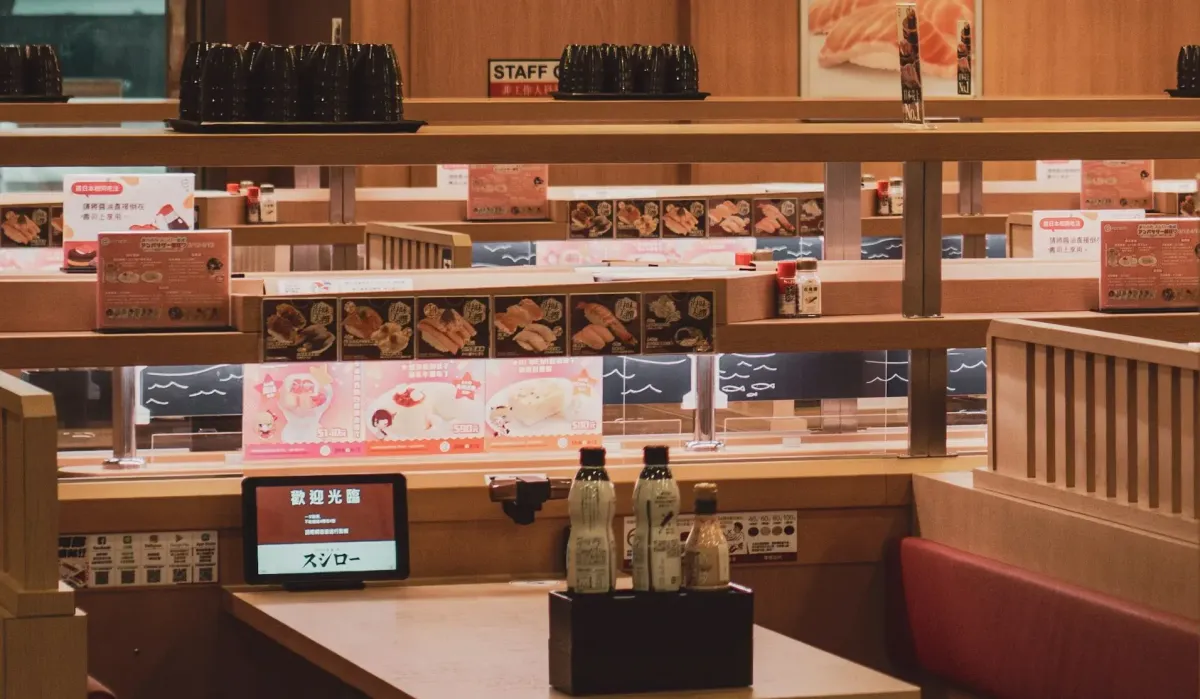
Anything not on the belt, you order on a touch panel. At Sushiro you choose English, Chinese or Korean on the screen, order there and pay there, as the chain's official English how-to explains. At Kura you can order on the panel or scan the table's code with your phone, and smartphone ordering is available in Japanese, English, Chinese (Simplified and Traditional) and Korean.
Ordered items arrive on a separate express lane, so they do not get mixed up with the belt. Sushiro delivers them to "your personal lane or in a personal cup", and Kura calls its version the order lane.
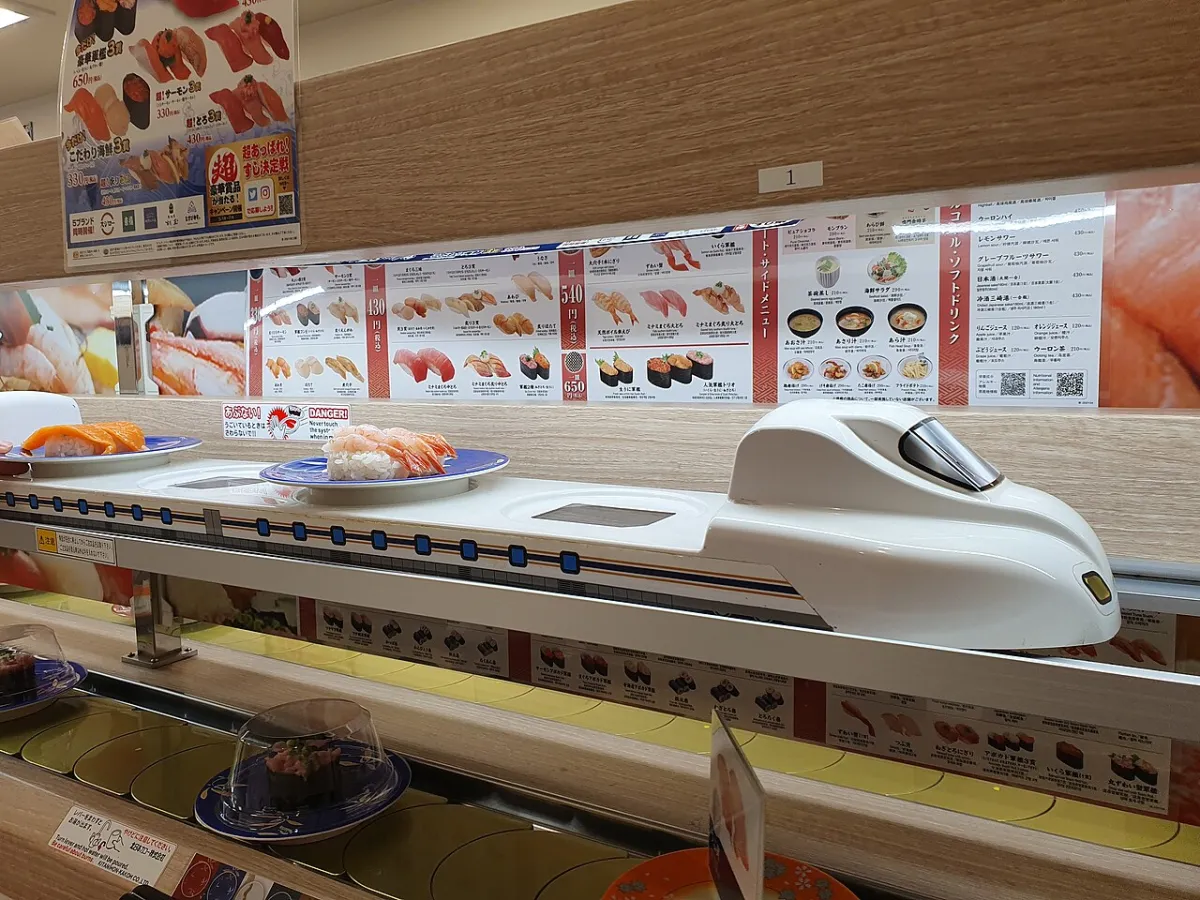
Photo by Syced / Wikimedia Commons (CC0)
Generic photo of an express-lane delivery train, not a branch listed in this guide.
Some "kaiten" shops no longer rotate sushi at all. Uobei's Tokyo stores are marked "no rotating lane" on the chain's official store list, and everything is made to order and sent out on the lane. Hama Sushi's Akihabara branch also lists a straight lane with lane ordering rather than a rotating one.
Counting plates and paying
Kura has a slot at the table where you drop finished plates. They are counted automatically, every five plates triggers a Bikkura-Pon prize game, and you pay at a self-checkout. At Sushiro the touch panel handles payment. At other shops staff or a counting machine tally the plates, and some shops charge a flat rate.
Tea, hot water, gari and soy sauce
Chopsticks, soy sauce, sweet sauce and powdered green tea are at your table. Kura's first-timer guide says to put about one teaspoon of tea powder in the cup and press the cup against the hot-water tap at the table. The water is hot, so take care.
Pickled ginger (gari), wasabi and soy sauce are self-serve. Wasabi is often left out of the sushi itself: Sushiro serves all sushi without wasabi and sends wasabi packets around the lane, and Kappa Sushi serves every item without wasabi. Sushiro's how-to shows soy sauce going on the topping.
Booking, queues and payment
Reservations and queueing vary by chain (see the table below), and most chains run them through an app. For payment, Sushiro takes cards and QR payments but no e-money, Kura's central branches take major cards and QR payments, and Kura says a few stores are cash-only. Hama accepts cash, cards and some e-money, though not at every store.
Allergies
Sushiro, Kura, Hama and Kappa all publish allergen information online, and Sushiro has an English allergen PDF. Hama also shows allergens on the order touch panel. Check the official page for the exact item.
How much it costs
Official base plates, tax included, as the chains publish them in 2026:
- Sushiro: from ¥120 a plate nationally on the English site, "items and prices may vary in some stores". Central Tokyo branches such as Shibuya Ekimae and Shinjuku East Exit show plates from ¥150.
- Kura Sushi: four nationwide tiers starting at ¥110, ¥115, ¥125 and ¥145. Every central Tokyo branch we checked is in the ¥145 tier.
- Hama Sushi: most items ¥110 a plate. Urban stores in Tohoku and Kanto use a separate menu where the same base item is ¥121, and nine central stores, including Akihabara Denki-gai-guchi, Ginza Inz and Ikebukuro Green Odori, differ again.
- Uobei: ¥110 items stay ¥110 at every Tokyo store. Tokyo stores are "urban" or "super-urban" (Shibuya Dogenzaka is one), and there all other items cost more than at regular stores.
- Kappa Sushi: basics such as salmon, shrimp, squid and tamago from ¥110, tuna from ¥120, with prices differing at some stores.
- Katsu Midori: from ¥154, mostly two pieces per plate, with the top item at ¥4,048.
Ten base plates cost about ¥1,450 at a central Kura or ¥1,500 at Sushiro Shibuya before drinks and extras. For a realistic meal, Tabelog's budget fields give a feel: Kura Shibuya ¥1,000 to ¥1,999, Uobei Dogenzaka ¥1,000 to ¥2,999, and Katsu Midori Meguro ¥2,000 to ¥2,999 at dinner. Check each price on the touch panel as you order.
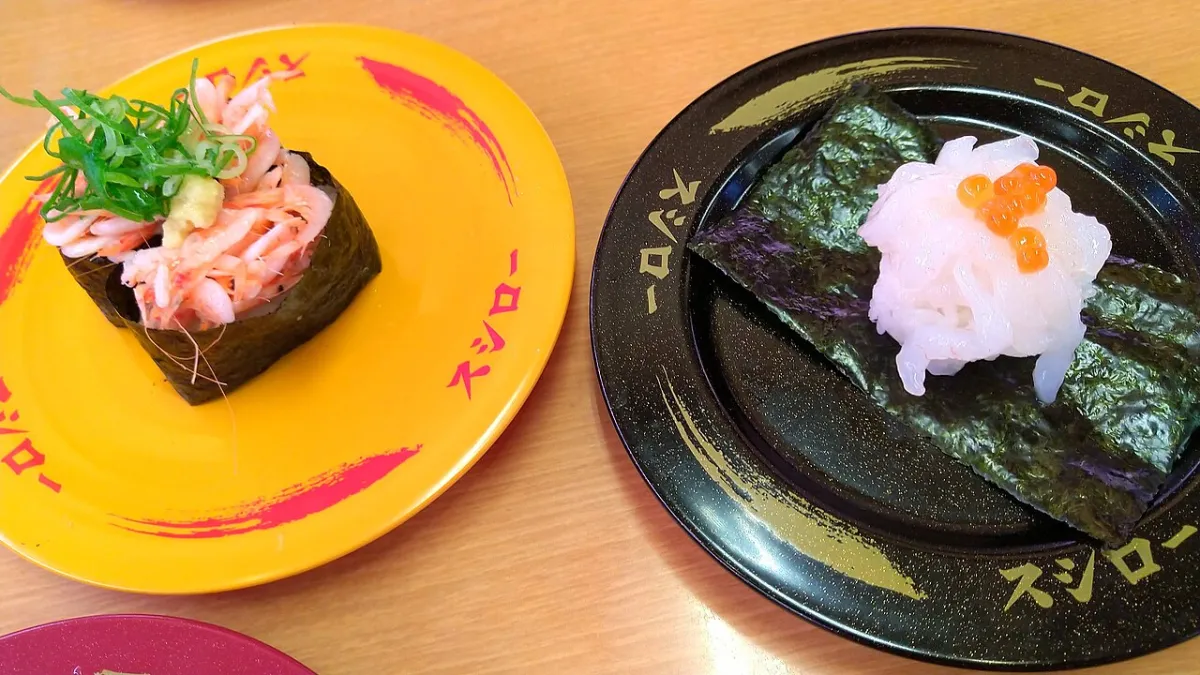
Photo by RuinDig/Yuki Uchida / Wikimedia Commons (CC BY 4.0)
Generic photo of Sushiro plates, not a branch listed in this guide.
The big chains compared
| Chain | Base plate price (tax incl.) | Ordering | Reservation | Notes |
|---|---|---|---|---|
| Sushiro | From ¥120 nationally, ¥150 at central Tokyo branches | Touch panel in English, Chinese and Korean | Sushiro app only, smartphone only, no phone bookings | Cards and QR, no e-money |
| Kura Sushi | Tiers from ¥110 to ¥145, central Tokyo ¥145 | Touch panel or phone; phone ordering in 5 languages | App, no-signup web booking or LINE | Plate slot and Bikkura-Pon game; 500+ stores |
| Hama Sushi | Mostly ¥110, urban Kanto ¥121, nine central stores differ | Touch panel with allergen info | App queue and timed bookings, no seat reservations | More than 600 outlets |
| Uobei | ¥110 items; other items cost more in urban stores | Tablet, express lane only in Tokyo | App queueing at most Tokyo stores | No rotating belt in Tokyo |
| Kappa Sushi | From ¥110, tuna from ¥120 | Check the store | Check the store | Every item without wasabi |
| Katsu Midori | From ¥154, mostly 2 pieces | Check the store | No reservations; live wait board online | Mostly 2 pieces per plate |
For a deeper chain-by-chain comparison, see our best sushi chains in Japan and the Kura Sushi Tokyo guide.
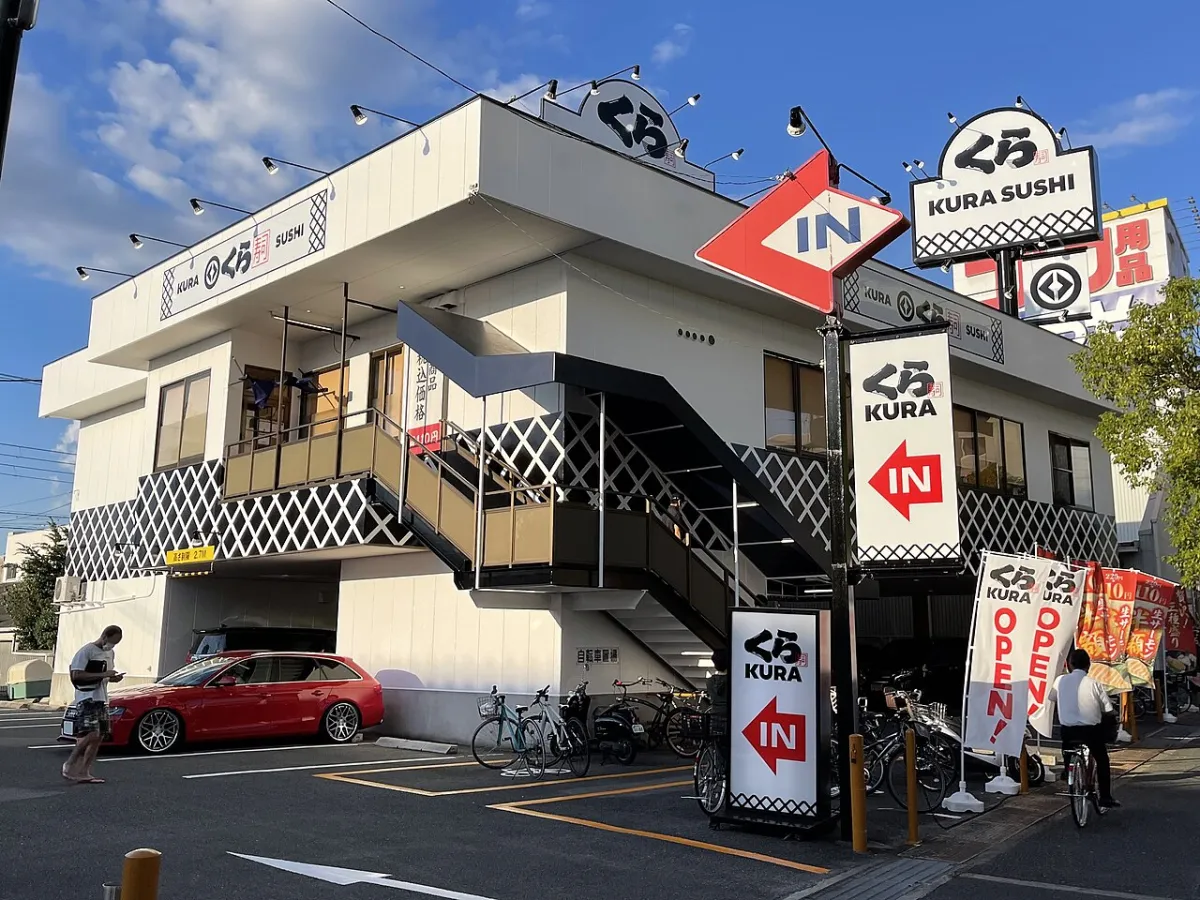
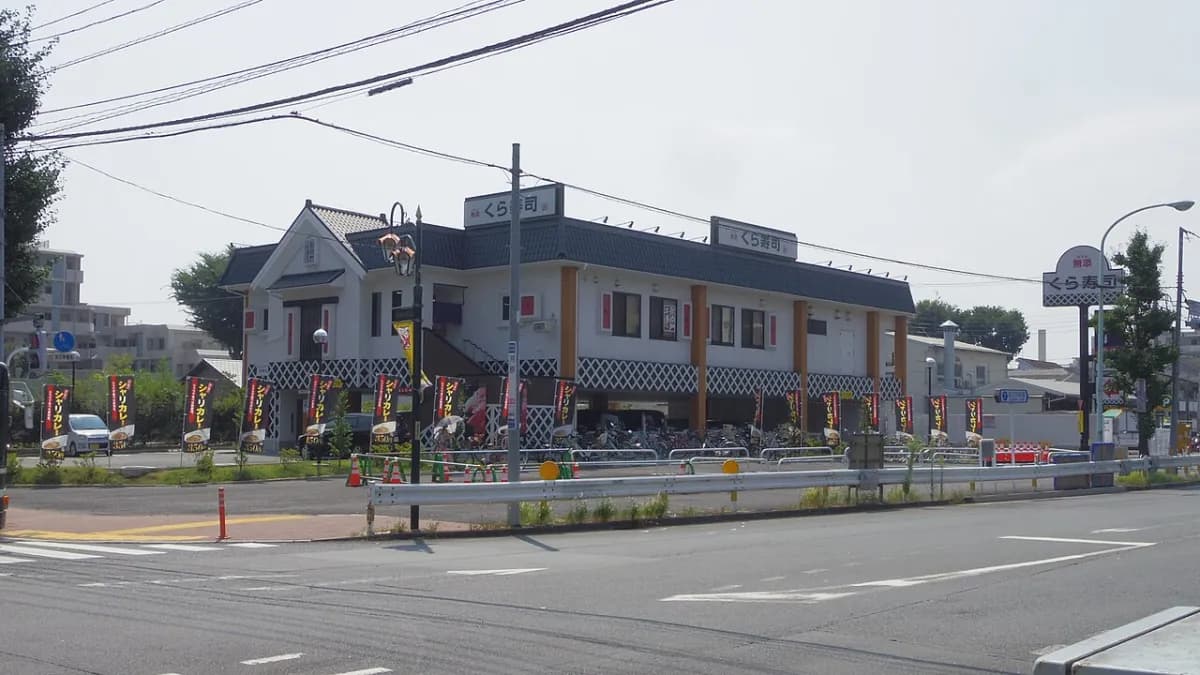
Photo by Tokumeigakarinoaoshima / Wikimedia Commons (CC BY-SA 4.0)
Generic photo of a Kura Sushi branch, not a branch listed in this guide.
Do not confuse Katsu Midori with Sushi no Midori. Sushi no Midori, which has branches such as Shibuya Mark City, is a sit-down restaurant, and Katsu Midori is its conveyor belt sister brand.
Etiquette: what the chains actually say
Etiquette lists online rarely say where their rules come from. We found only a few that the chains themselves publish:
- Sushiro's three official rules: do not leave or return your plate onto the lane, do not lean on the lane, and do not put anything on the lane.
- Kura's hygiene system: plates on the belt sit under covers that you open with a button, and a QR-based system discards plates after a set time on the belt, as described on Kura's food safety page.
At Sushiro, once you take a plate, do not put it back. Beyond that, we found no official source for other rules you may see online.
Where to try it in Tokyo
Six branches that show different sides of kaiten sushi, each checked against its official page or Tabelog in 2026. For more in each area, see the Tokyo conveyor belt sushi guide, Shibuya, Shinjuku, Akihabara and Ueno.
1. Sushiro Shibuya Ekimae (スシロー 渋谷駅前店): an easy first try
A Sushiro branch with an English touch panel, one minute from Shibuya Station. Plates start at ¥150 at this branch. Our Shibuya conveyor belt sushi guide has more options in the area.
- Location: Highmanten Bldg 6F, 23-5 Udagawacho, Shibuya-ku
- Hours: Mon-Fri 11:00-23:00; Sat, Sun, holidays 10:30-23:00; last order 30 min before closing
- Reservation: Sushiro app only
- Official store page
2. Kura Sushi Global Flagship Asakusa ROX (くら寿司 グローバル旗艦店 浅草ROX): the full Kura system
Covered plates on the belt, an order lane, the plate slot and the Bikkura-Pon game, in the main sightseeing area. Plates start at ¥145, with some items priced differently at this branch, and the touch panel supports four languages. See the Kura Sushi Tokyo guide for more branches.
- Location: Asakusa ROX 4F, 1-25-15 Asakusa, Taito-ku
- Nearest station: Tsukuba Express Asakusa Station, about 130 m (Tabelog)
- Hours: Mon-Fri 11:00-23:00; Sat, Sun 10:20-23:00; last entry 30 min before closing
- Reservation: App, web or LINE; phone 03-5830-6106
- Official store page
3. Uobei Shibuya Dogenzaka (魚べい 渋谷道玄坂店): kaiten without the belt
No rotating lane: everything is ordered on a tablet and delivered by express lane. ¥100 items cost ¥110, and as a "super-urban" store other items cost more than at regular Uobei stores. It has 121 seats including a counter, and the official site does not say whether the panel has English, so check on the day.
- Location: Dai-6 Central Bldg 1F, 2-29-11 Dogenzaka, Shibuya-ku
- Nearest station: Shibuya Station, 3 min (Hanzomon, Den-en-toshi lines) to 5 min (JR Hachiko Exit)
- Hours: Mon-Fri 11:00-23:00; Sat, Sun, holidays 10:30-23:00; last order 22:30
- Reservation: None
- Official store list
4. Hama Sushi Akihabara Denkigai-guchi (はま寿司 秋葉原電気街口店): a big budget chain
A straight-lane store with lane ordering. This branch is one of Hama's stores priced differently from even the urban menu, and exact prices are not published online, so check the touch panel. The chain-wide base is ¥110 a plate. See also our Akihabara conveyor belt sushi guide.
- Location: BiTO AKIBA PLAZA 3F, 1-18-18 Sotokanda, Chiyoda-ku
- Nearest station: JR Akihabara Station, Electric Town side
- Hours: Mon-Fri 11:00-23:00; Sat, Sun, holidays 10:00-23:00; last entry 30 min and last order 15 min before closing
- Reservation: Hama app for queue and timed bookings, no seat reservations
- Official store page
5. Nemuro Hanamaru KITTE Marunouchi (回転寿司 根室花まる KITTE丸の内店): a Hokkaido chain by Tokyo Station
A conveyor belt shop in the Tokyo Station area. Prices are not on the official store page, so check at the shop. Seats are not reservable: a ticket machine hands out queue tickets once the shop is full, and ticketing can close early on busy days.
- Location: JP Tower (KITTE Marunouchi) 5F, 2-7-2 Marunouchi, Chiyoda-ku
- Hours: 11:00-22:00; last order 21:30
- Reservation: None
- Official store page
6. Katsu Midori Atre Meguro (回し寿司 活 活美登利 目黒店): mid-price with bigger toppings
Plates start at ¥154 and are mostly two pieces, and Tabelog's genre is conveyor belt sushi. It is connected to Meguro Station, and Tabelog gives a dinner budget of ¥2,000 to ¥2,999. Katsu Midori's Seibu Shibuya branch closed on 30 September 2026, so do not plan on that one.
- Location: Atre Meguro 2, 1F, 3-1-1 Kamiosaki, Shinagawa-ku
- Nearest station: Directly connected to Meguro Station (Tokyu Meguro, Toei Mita, Namboku); JR Meguro 2 min (Tabelog)
- Hours: 11:00-22:00 daily (Tabelog)
- Reservation: None; live wait info on the official wait board
- Tabelog page
FAQ
- What is kaiten sushi?
- Kaiten sushi (回転寿司, also written kaiten zushi) is conveyor belt sushi. Plates of sushi travel past every seat on a belt and you take the ones you want. Items that are not on the belt can be ordered on a touch panel and are delivered on a separate lane.
- Who invented conveyor belt sushi and when?
- According to the Osaka Convention & Tourism Bureau, it was invented in Osaka. The founder of Genroku Sangyo, who ran a standing sushi shop in Fuse (now Higashiosaka), got the idea from bottles on a belt conveyor at a beer factory. The first shop with a rotating dining table opened in 1958, and the 1970 Osaka Expo made it famous across Japan.
- How much does conveyor belt sushi cost in Tokyo?
- Official base plates are about ¥110 to ¥150 including tax: Sushiro is ¥150 at central Tokyo branches, Kura ¥145, Hama mostly ¥110 (¥121 at urban Kanto stores) and Uobei ¥110 for its base items. Tabelog budget ranges for the Tokyo branches we checked run from ¥1,000 to ¥3,999 per person.
- How do I order in English at Sushiro or Kura?
- Sushiro's touch panel offers English, Chinese and Korean, and you also pay there. Kura's touch panel and smartphone ordering support English, and smartphone ordering also covers Japanese, Chinese and Korean.
- How do I make green tea at a conveyor belt sushi table?
- Put about one teaspoon of the powdered green tea from your table into the cup, then press the cup against the hot-water tap at the table. The water is hot, so be careful.
- Is wasabi included at conveyor belt sushi?
- Often not. Sushiro serves all sushi without wasabi and sends wasabi packets around the lane, and Kappa Sushi serves every item without wasabi. Pickled ginger, wasabi and soy sauce are self-serve at most places.
- Can I put a plate back on the belt?
- At Sushiro, no: its official rules say not to leave or return your plate onto the lane.
- Do I need a reservation for Sushiro or Kura?
- Not always, but you can reserve. Sushiro bookings are through its app only, with no phone bookings. Kura takes bookings through its app, a web page with no sign-up, or the store's LINE account. Hama Sushi has no seat reservations, only queue and timed bookings in its app.
Plan your visit
Start with Sushiro Shibuya Ekimae or Kura Asakusa ROX if it is your first time, and book on the chain's app or website if you are going at a busy hour. If you want a cheaper beltless option, try a standing bar like standing sushi bar in Shinjuku, where the chef hands each order across the counter, or step up to a chef's-choice meal with our omakase guide. For a wider look at sushi formats, see best sushi in Tokyo.